Is Crestwood Screwed?
Recently, the Post-Dispatch and Don Corrigan's community paper, the Webster-Kirkwood Times, and the less well-regarded Call Newspapers of South County have spent a fair amount of ink belaboring the point that the City of Crestwood MO seems to be in the throes of a severe fiscal crisis.
But perhaps I'm being too sensationalistic. What's happening, according to the June 30th P-D, the July 6th Call and today's Political Fix (the Jo Mannies blog - although Phil Sutin contributed this item), Crestwood is considering "defeasing" a 2002 issue of almost $10 million in bonds intended to finance the expansion and remodeling of its City Hall and Police Department complex. (About a year ago, they dropped an earlier plan to build a completely new Police building, because of dramatic cost overruns in the design phase.)
This topic will be discussed at tomorrow's Crestwood Board of Aldermen meeting. This follows closely on the heels of the Board's unanimous June 28 decision to cancel a temporary lease planned with Crestwood Plaza for the City to occupy space in the mall during the remodeling of the government center. They did this because over 2,000 signatures were gathered to force a referendum on the lease proposal.
Jim Murphy, the former Republican state representative from Crestwood who was a harsh critic of the Busch Stadium public financing proposal, was among the leaders of that petition drive, under the auspices of a group called Crestwood Citizens For Fiscal Responsibility.
Defeasance is not necessarily a bad thing; it pretty much means paying off bonds early. In this case, however, it's being done because the project is apparently being scrapped, and will cost Crestwood several hundred thousand dollars in fees and charges to, among others, their financial advisor, WM Financial Strategies of Creve Coeur.
The lowest bid on the renovation project was about $1 million over the amount of funds available to complete the project. So it seems likely the project will be canceled.
What's happening in Crestwood is a bit surprising, given that it certainly is not an impoverished community. According to 2000 US Census data, Crestwood has:
median household income of $54,185
median housing value of $130,800
unemployment rate 2.8%
This doesn't seem like a prime candidate for fiscal crisis. However, Crestwood has historically provided a lot of expensive municipal services, including:
Police Department
Fire Department (does not serve the far eastern part of the city, annexed in the 1990s and located in the Affton Fire Protection District)
Parks and Recreation Department including the historic 1808 Federal style Thomas Sappington House, a large Aquatic Center located in 85 acre Whitecliff Park, several smaller parks, and its own Animal Control division.
Solid Waste pickup service including a pretty affordable Curbside Recycling program.
For a city of less than 12,000 residents, that's very extensive services. They don't run a library, because they're part of St. Louis County Library district, which has a branch nearby in Oakland. They also have four wards, with eight aldermen total. That suggests each alderman represents about 1,500 people.
So, how is this financed?
Traditionally, by sales taxes. And therein lies the rub.
Most of Crestwood (except for the mentioned late 1990s annexation area east of Grant Road), is a "point-of-sale" city, which means sales tax revenues collected there (through the 1.00% St. Louis County sales tax), stay there. The annexation area is a "pool" city, which means it gets a share of St. Louis County-wide sales tax revenues, based on population.
Also, Crestwood levies several additional sales tax rates: the "local option" for general revenue (0.25%); fire tax (0.25%); parks and storm water (0.50%); and capital improvements (another 0.50%). As a result, with the state and other regional sales taxes added in, the total sales tax rate charged in Crestwood is 7.575%, tied with several other retail-heavy towns for the highest rate in St. Louis County. About 54% of Crestwood's general revenues come from sales tax. Crestwood also levies a relatively small $0.25 per $100 assessed valuation real estate tax on residential, commercial and personal property.
What's happened in the past five years or so is that Crestwood has continued with their traditional ways of getting revenue, but thost revenue sources have started to decline. Crestwood Plaza, among the best malls in town through the early 1990s (remember "The Ultra Mall"?), known now as Westfield Crestwood, has lost a number of prime tenants over the past two years like California Pizza Kitchen, Banana Republic and B. Dalton. The recent mergers and acquisitions involving Sears and Famous-Barr, two of its three anchors, raise further concerns.
(I would note that my grandmother years ago worked in the cafeteria at the Crestwood Stix, Baer & Fuller, retiring about the time it was bought out by Dillard's in the mid-1980s). Further, the AMC Crestwood 10 cinema complex in the mall has an uncertain future given the recent merger of AMC with Lowes cinemas.
Outside the mall, the surrounding strip centers have suffered. A former Service Merchandise store less than one mile west of the mall still sits vacant. Likewise, about 1 1/2 miles east, near the border with Webster Groves, Crestwood Square strip mall is mostly vacant, with a sporting goods store and an office supply store having vacated a couple years ago. And, most ominously, the former Circuit City directly across from the mall is now partly occupied by Aldi, the deep-discount grocery chain.
While a new Kohl's department store was built in 2003, it was a controversial project, because it required demolishing the high-rise Crestwood Office Center, a drive-thru bank branch at the base of the office tower, and a former Schnucks grocery store on Sappington Road; as well as the relocation of the private Crestwood Swim Club. This required the use of Tax Increment Financing, which means the City of Crestwood is sacrificing most of its potential sales tax revenues from the project.
Overall, the Crestwood saga suggests that the typical suburban development patterns and heavy reliance by municipal governments on sales taxes, are unsustainable. Crestwood now needs to seriously consider what its future will be. Will the 1960s ranch houses that dominate the landscape really continue to be marketable in, say, 20 years? What will happen to the mall if Famous-Barr / Macy's, Sears / K-Mart, and AMC / Lowes abandon it, like some of the smaller chains already have? Likewise, what about the proposed mega-development on the site of the Sunset Manor subdivision (and Bob Evans) in Sunset Hills at I-44 and Lindbergh. Karl Bissinger's chocolates, one of the few places that still is a draw (for me, anyway) at Crestwood, has signed on for a larger operation there. A large cinemaplex is also planned there. Will that kill any potential for Crestwood retail revival?
Perhaps Crestwood should consider remaking the mall into something reflecting New Urbanism, which seems to be getting popular in St. Charles and Richmond Heights. It's already well-served by public transit (buses, anyway).
In the immediate future, maybe service cuts will be necessary - i.e., making the Sappington House and the Animal Shelter independent non-profits, or convincing St. Louis County to take them over. And contracting with St. Louis County for police services, and/or merging the fire department with Kirkwood, Webster Groves, Affton FPD, or Mehlville FPD, should be seriously considered. The City of Crestwood can regain its financial footing, but only by making tough choices.
Monday, July 11, 2005

Friday, July 08, 2005
Gassy St. Louis
In the wake of yesterday's horrific attacks on London commuters, many people have been pondering the safety of public transit.
Meanwhile, in the wake of the June 24th fire and explosions at Praxair in the Lafayette Square neighborhood, many people have been pondering just how safe it is to live near industrial facilities that process volatile chemicals and gases.
I am concerned that these two issues could potentially be related, at least indirectly. Very near the Grand Avenue MetroLink station in Midtown St. Louis, is a terminal for a company called Airgas Mid-America (formerly Gateway Airgas). The address is 3500 Bernard Street.
I don't know what sort of gases are processed at Airgas Mid-America, however the Washington University Purchasing Department classifies both Airgas Mid-America and Praxair as preferred vendors for "cylinder gases." More specifically, here are the products they each offer, according to the WashU site.
Airgas Mid-America, 3500 Bernard St.
Argon, carbon dioxide, helium, nitrogen oxygen, etc.
Praxair Distribution, 2210 Chouteau Ave.
Argon, carbon dioxide, helium, nitrogen oxygen, etc.
Sounds pretty similar to me. Of course, the real concern would be if both were distributors of highly flammable gases like acetylene. Airgas Mid-America does distribute acetylene, and the 3500 Bernard St. location is described on their website as the following:
Branch
Fill Plant
Specialty Gas Lab - Regional
Equipment Rental
Medical Branch
Sounds pretty similar to the Praxair operation at 2210 Chouteau Ave.
So, what's the concern?
Here's an aerial view of Praxair and vicinity. In the center of the photo is the intersection of Hickory St. and Mackay Pl.

Here's an aerial view of Airgas Mid-America and vicinity. In the center of the photo is the Grand Avenue MetroLink station platform.
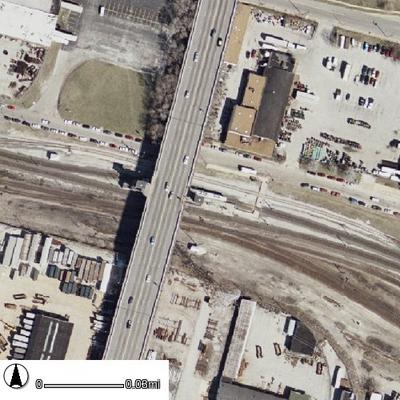
The Airgas Mid-America facility, while not near any residences, is nevertheless quite close to the MetroLink platform, and even closer to the bus stops on Scott Ave. that serve the Manchester, Lindenwood, and Sarah MetroBus routes.
A related question is that of zoning. Praxair executives consistently claim their property is zoned for that type of operations. Both the Praxair and Airgas locations are zoned J-Industrial. This means, according to the City zoning code, that "The use regulations are the same as those in the I central business district." This suggests that, among other restrictions, "A building or premises may be used for any purpose except... acetylene gas manufacture; ...gas manufacture or storage" (Section 26.52.020, City of St. Louis Revised Code; emphasis added).
So are these sites REALLY zoned for such usage? They MAY have conditional use permits, but they appear to be questionable in their compliance with the formal zoning restrictions for the J-Industrial zoning district.
Finally, it is worth noting there is a redevelopment plan, approved in 1986 by city ordinance, on file for the Praxair parcel. It calls for the site to be converted to residential and commercial (non-industrial) uses. I can't find the document, but I think it was called the Lafayette Square Northwest plan.
While Airgas Mid-America may not be part of a redevelopment area, it certainly falls within the territory desired by St. Louis University for campus expansion and integration. Perhaps the rebuilding of the Grand Avenue viaduct will provide an opportunity to buyout the Airgas Mid-America property, and replace it with something more appropriate and safe for a location so proximate to a high-volume public transit facility. And, maybe, just maybe, Metro would consider using the property for a park-ride lot that city residents could actually use, instead of parking on narrow Scott Avenue!
In the wake of yesterday's horrific attacks on London commuters, many people have been pondering the safety of public transit.
Meanwhile, in the wake of the June 24th fire and explosions at Praxair in the Lafayette Square neighborhood, many people have been pondering just how safe it is to live near industrial facilities that process volatile chemicals and gases.
I am concerned that these two issues could potentially be related, at least indirectly. Very near the Grand Avenue MetroLink station in Midtown St. Louis, is a terminal for a company called Airgas Mid-America (formerly Gateway Airgas). The address is 3500 Bernard Street.
I don't know what sort of gases are processed at Airgas Mid-America, however the Washington University Purchasing Department classifies both Airgas Mid-America and Praxair as preferred vendors for "cylinder gases." More specifically, here are the products they each offer, according to the WashU site.
Airgas Mid-America, 3500 Bernard St.
Argon, carbon dioxide, helium, nitrogen oxygen, etc.
Praxair Distribution, 2210 Chouteau Ave.
Argon, carbon dioxide, helium, nitrogen oxygen, etc.
Sounds pretty similar to me. Of course, the real concern would be if both were distributors of highly flammable gases like acetylene. Airgas Mid-America does distribute acetylene, and the 3500 Bernard St. location is described on their website as the following:
Branch
Fill Plant
Specialty Gas Lab - Regional
Equipment Rental
Medical Branch
Sounds pretty similar to the Praxair operation at 2210 Chouteau Ave.
So, what's the concern?
Here's an aerial view of Praxair and vicinity. In the center of the photo is the intersection of Hickory St. and Mackay Pl.

Here's an aerial view of Airgas Mid-America and vicinity. In the center of the photo is the Grand Avenue MetroLink station platform.

The Airgas Mid-America facility, while not near any residences, is nevertheless quite close to the MetroLink platform, and even closer to the bus stops on Scott Ave. that serve the Manchester, Lindenwood, and Sarah MetroBus routes.
A related question is that of zoning. Praxair executives consistently claim their property is zoned for that type of operations. Both the Praxair and Airgas locations are zoned J-Industrial. This means, according to the City zoning code, that "The use regulations are the same as those in the I central business district." This suggests that, among other restrictions, "A building or premises may be used for any purpose except... acetylene gas manufacture; ...gas manufacture or storage" (Section 26.52.020, City of St. Louis Revised Code; emphasis added).
So are these sites REALLY zoned for such usage? They MAY have conditional use permits, but they appear to be questionable in their compliance with the formal zoning restrictions for the J-Industrial zoning district.
Finally, it is worth noting there is a redevelopment plan, approved in 1986 by city ordinance, on file for the Praxair parcel. It calls for the site to be converted to residential and commercial (non-industrial) uses. I can't find the document, but I think it was called the Lafayette Square Northwest plan.
While Airgas Mid-America may not be part of a redevelopment area, it certainly falls within the territory desired by St. Louis University for campus expansion and integration. Perhaps the rebuilding of the Grand Avenue viaduct will provide an opportunity to buyout the Airgas Mid-America property, and replace it with something more appropriate and safe for a location so proximate to a high-volume public transit facility. And, maybe, just maybe, Metro would consider using the property for a park-ride lot that city residents could actually use, instead of parking on narrow Scott Avenue!
Wednesday, July 06, 2005
Vicissitudes of Globalization Hit Lesotho
This isn't about St. Louis, or urban issues, but it is depressing.
BBC News reports on the precipitous decline of the textile industry in Lesotho, the tiny mountain kingdom completely surrounded by South Africa.
Only three years ago, main concerns were about the rapid expansion of textile making in Lesotho. At that time, textile-making had becoming the number one industry in Lesotho, replacing the long-time tradition of Sotho men working as migrant workers in South African gold and diamond mines, whose fortunes were dwindling.
The blame for this sudden decline of nascent manufacturing, according to BBC, falls heavily on Chinese-American monetary policies, because "the Chinese and Taiwanese [factory] owners have now gone home, after China was given better access to US markets and a fall in the US dollar."
Of course, some blame probably falls on South Africa, too. Essentially, the Central Bank of Lesotho has very limited power, because the Common (Rand) Monetary Area (CMA) and Southern African Customs Union (SACU) ensure there can be no duties on most goods traded between SA and Lesotho, and that the Lesotho loti must trade one-to-one with the SA Rand.
While Lesotho benefits from these arrangements to some extent, South Africa is clearly the senior partner in the arrangement. Lesotho, along with Namibia and Swaziland, all countries with tiny populations, are pretty much along for the ride. Botswana has somewhat more leeway, as its currency is not part of the CMA, but it is part of the SACU. These relationships were established during apartheid, but they haven't really changed dramatically in ten years of multiparty democracy in South Africa.
This should be no surprise - it works out quite well for the SA government! As many readers may know, I spent a semester as an exchange student at the University of the Western Cape, a solidly and proudly leftist institution, almost five years ago. While I love that part of the world and many of its people, I recognize that no country or political system is perfect. While I applaud South African leadership of many beneficial activities for the African continent as a whole, they still wield a great deal of power over their immediate neighbors.
Subscribe to:
Posts (Atom)

